Where we started
At the start of 2026, AI was already part of how ddx worked. Our engineers used it to review code. Our finance team used it to check the monthly accounts. Our project managers used it to draft plans and reports.
What we didn’t have was a shared way of doing it. Good habits lived in individual heads. Two people could do the same task two different ways, with two different levels of checking, and nobody could say where AI was saving time or where it was adding risk.
The Project Management Institute (PMI), the global professional body for project managers, describes this exact situation in its guidance on AI: risk is highest where individual use runs ahead of agreed practice. So this year wasn’t about starting to use AI. It was about making what we already did consistent, governed and measurable.
The early signs are good. Our headcount hasn’t changed all year, yet revenue has grown 10%. That growth didn’t come from large new contracts. It came from the clients we already had, because AI gave our teams the capacity to deliver more for them and to take on new streams of work. For those clients, that meant more delivered by the team they already knew.
Why we chose PMI’s standard
Project and programme management is a large part of what we sell. When PMI published The Standard for Artificial Intelligence in Portfolio, Program, and Project Management, it was written for the work we do every day. It made sense to run it on ourselves before taking it to clients.
The standard sets out eight principles and five performance domains (the areas of a project where performance is judged), and expects each firm to tailor them. We turned each principle into a plain rule that fits our team, working across different countries and time zones. Here’s how each one translates:
| PMI principle | What it means at ddx |
|---|---|
| Strategic value | Every use of AI has to improve delivery quality, save operations time or build know-how we can reuse. Novelty isn’t a reason. |
| Risk and human oversight | A named person signs off any AI output that reaches a client, a tax filing or a payment. |
| Governance and compliance | One ddx AI policy. No ddx or client data goes into an AI tool without written approval. |
| People and culture | Experiments are encouraged, but they’re shared, not kept in one person’s head. |
| Ethics and professional responsibility | Client confidentiality comes first, we tell clients when AI is used where it matters, and AI is never the sole basis for a material decision. |
| Stakeholder engagement | Clients and the team know when and how AI is used, so nobody is left assuming. |
| Optimisation | Our AI tools are treated as products and improved every quarter. |
| Data quality | Inputs are checked before the AI starts work, not after the output looks wrong. |
Then we tested our own AI Usage Framework, written in May, against all eight principles. It was strong on conduct and risk, and lighter on strategy, measurement and data quality. That gap set our agenda for the rest of the year.
What it looks like on an ordinary day
A framework only matters if it changes what people do on a Tuesday morning. Here’s where it shows up.
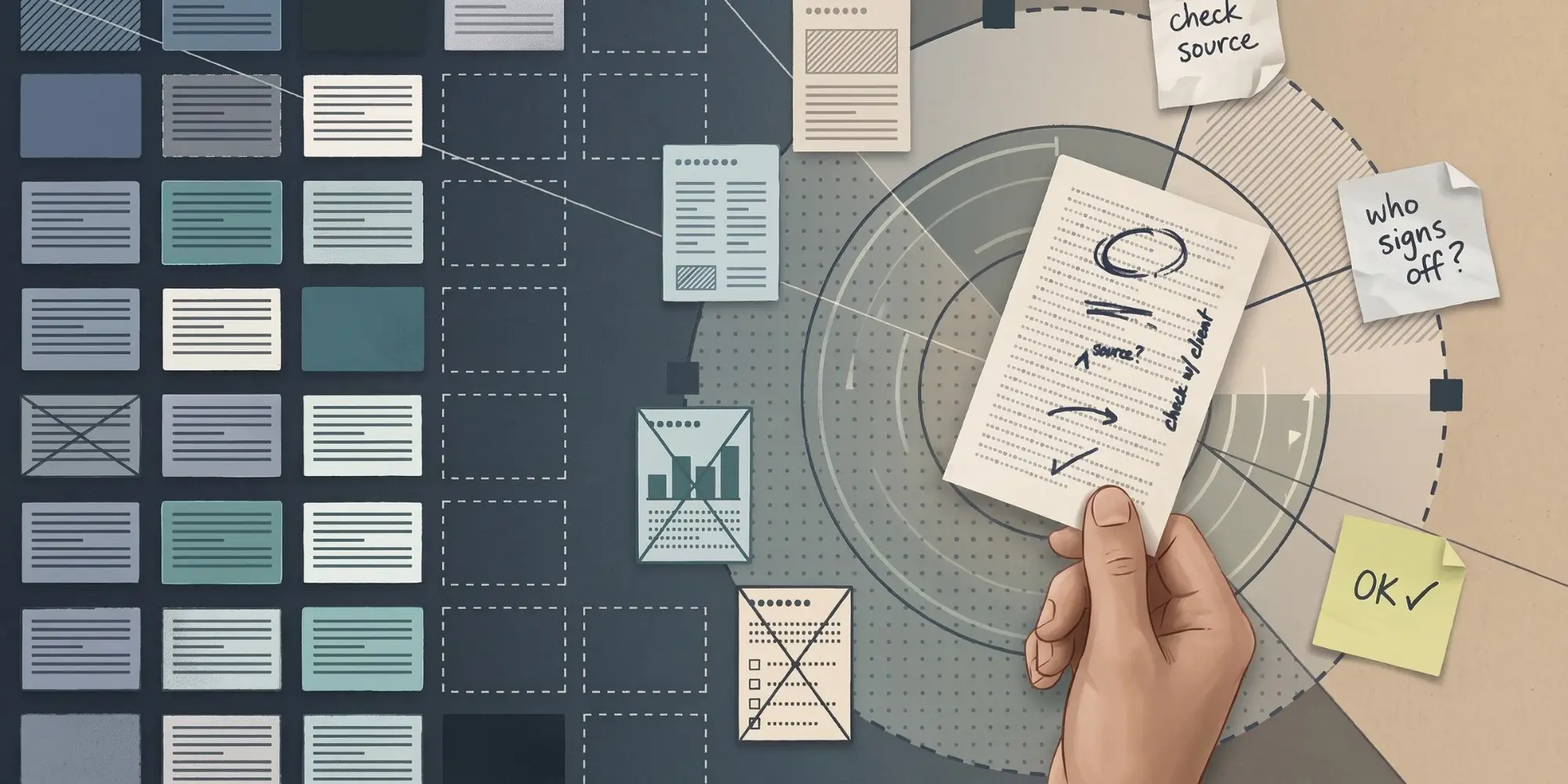
One rule sits above everything. Our handbook opens with four words: AI drafts, humans decide. AI researches, drafts and keeps documents and boards up to date. A named person makes the decisions, talks to the client and signs off. Someone is always accountable for anything that leaves ddx.
Every piece of work gets the right level of checking. Our AI Working Standard sets three levels of review. Notes and first drafts that stay with you can use AI freely. Anything a colleague will act on, like a ticket or a code change, is read line by line, with every number checked against its source. Anything a client sees gets a second person’s sign-off before it leaves ddx, and every figure in it shows where it came from.
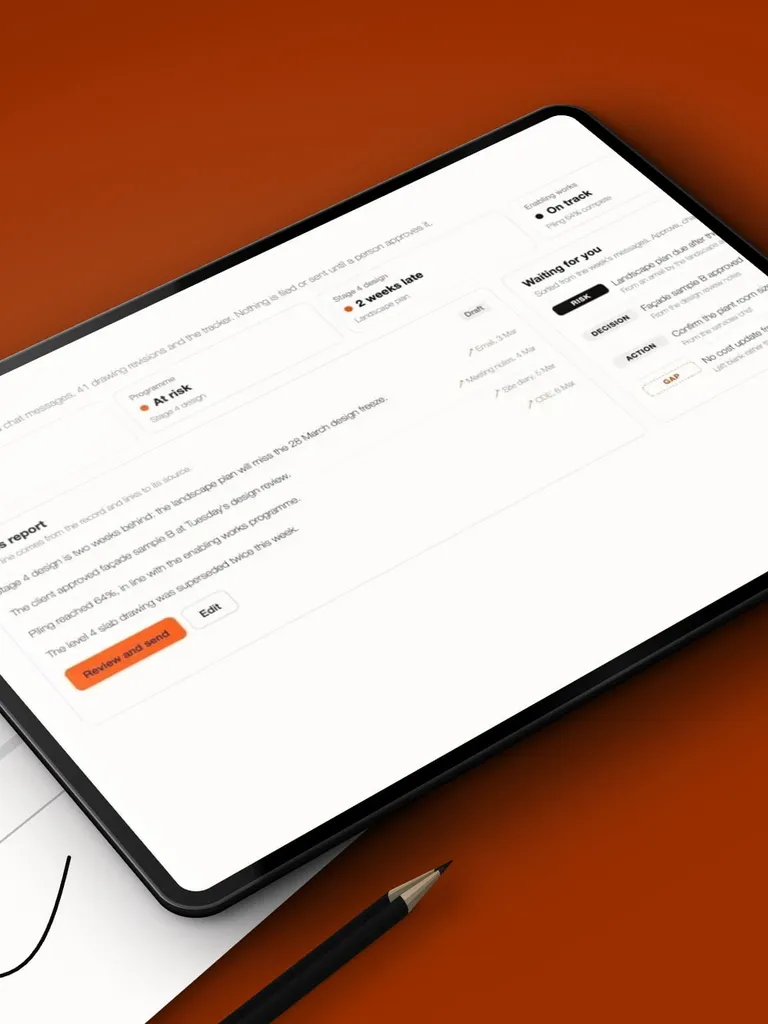
Every project runs on the same plays. Our Ways of Working Playbook takes each engagement through five phases, from winning the work to closing it and spotting what comes next, and sets out 23 plays across them. Each play names its owner, what AI does, what the person does, and the quality gate the output has to pass. No AI-written code is merged without a developer reviewing it. No status report reaches a client without the project manager’s approval.
Our standards are applied by default. We’ve written standards for tickets, feature specifications, technical documentation and plain English. Each one has a matching AI skill (a set of instructions that teaches the AI to do one task the ddx way) that applies it, so the standard is built into the work rather than checked for afterwards.
Finance runs on checked routines. Payroll, tax returns, VAT returns and project margin reports each have an AI routine that reconciles the numbers and flags anything unusual. A named person reviews the flags and signs off. AI never files or pays anything on its own.
Two small habits keep it honest. Any AI output that hasn’t been checked is labelled “AI draft, not yet checked”. And if a tool hits its limit or can’t do the job, you stop and say so the same day, rather than pushing half-finished work through to meet a deadline.
The same approach runs through the rest of our work. Code on every project is reviewed against one ddx standard. Daily stand-ups start from the task board, not from memory. Inputs are checked before AI starts work, and every AI risk has a named owner and a review date.
Working with AI is part of every role
A way of working only sticks if it shapes how people are assessed and how they grow. So we’ve built AI into our role profiles, which follow SFIA (the Skills Framework for the Information Age), the global framework for describing skills and levels of responsibility in digital work.
We’ve added “Working with AI” as an attribute at every SFIA level. It describes a behaviour, not a set of tools or prompts, and what’s expected grows with responsibility. Someone early in their career uses approved AI tools and checks the output against its sources. A team lead reviews the team’s AI work and acts as the named reviewer on anything a client sees. Our most senior people set ddx’s approach to AI and are accountable for it.
The two frameworks work together. PMI tells us how AI should work across a project. SFIA tells us what we expect of each person doing that work, at every stage of their career.
What didn’t go to plan
Some of it was harder than we expected.
Adoption was uneven. Engineering and finance moved fastest, because their work repeats. Research and creative work moved more slowly, because that work is less repeatable and the AI tools for it were the weakest. Those are the gaps we’re now working to close.
Measuring it was harder than writing it. Writing down how each play should work was the easy part. Showing that people actually follow it, and how much time AI saves, took longer, because at first we had no way to track either.
Our first policy covered conduct, not value. It told people how to use AI safely, but not where it was worth using. So we added a strategy layer above it, with a simple test for every new idea: does it create value, is it safe, and do we have the data to support it?
What this means for clients
If you work with ddx, you’ll notice three things.
- You’ll always know who’s accountable. Every deliverable has a named owner who has reviewed it. AI drafts; a person decides.
- Your data is handled to a known standard. No client data goes into an AI tool without written approval from ddx, and we keep that data where it’s allowed to live, whichever country’s rules apply.
- The method we sell is the method we use. The PMO (project management office) approach we bring to your programme is the one we run on our own projects every week. We’ve already found its weak spots, so you don’t have to.
What comes next
Next, the focus shifts to the detail. We know the overall result. What we can’t yet show is which plays contribute most to it. That means measuring the time saved and rework avoided on every play, reviewing our risks every month, and feeding what we learn into the AI-enabled PMO platform we’re building for us and our clients.
This year turned an ambition into a working practice. If you’d like to do the same, the place to start is the ddx AI Audit. In two weeks, it shows you what AI your teams are running, including the tools nobody approved, where that leaves you exposed and where it’s worth scaling. We score what we find against the same PMI standard we’ve adopted ourselves, and you leave with a six-month roadmap that’s yours to run in-house or with us.