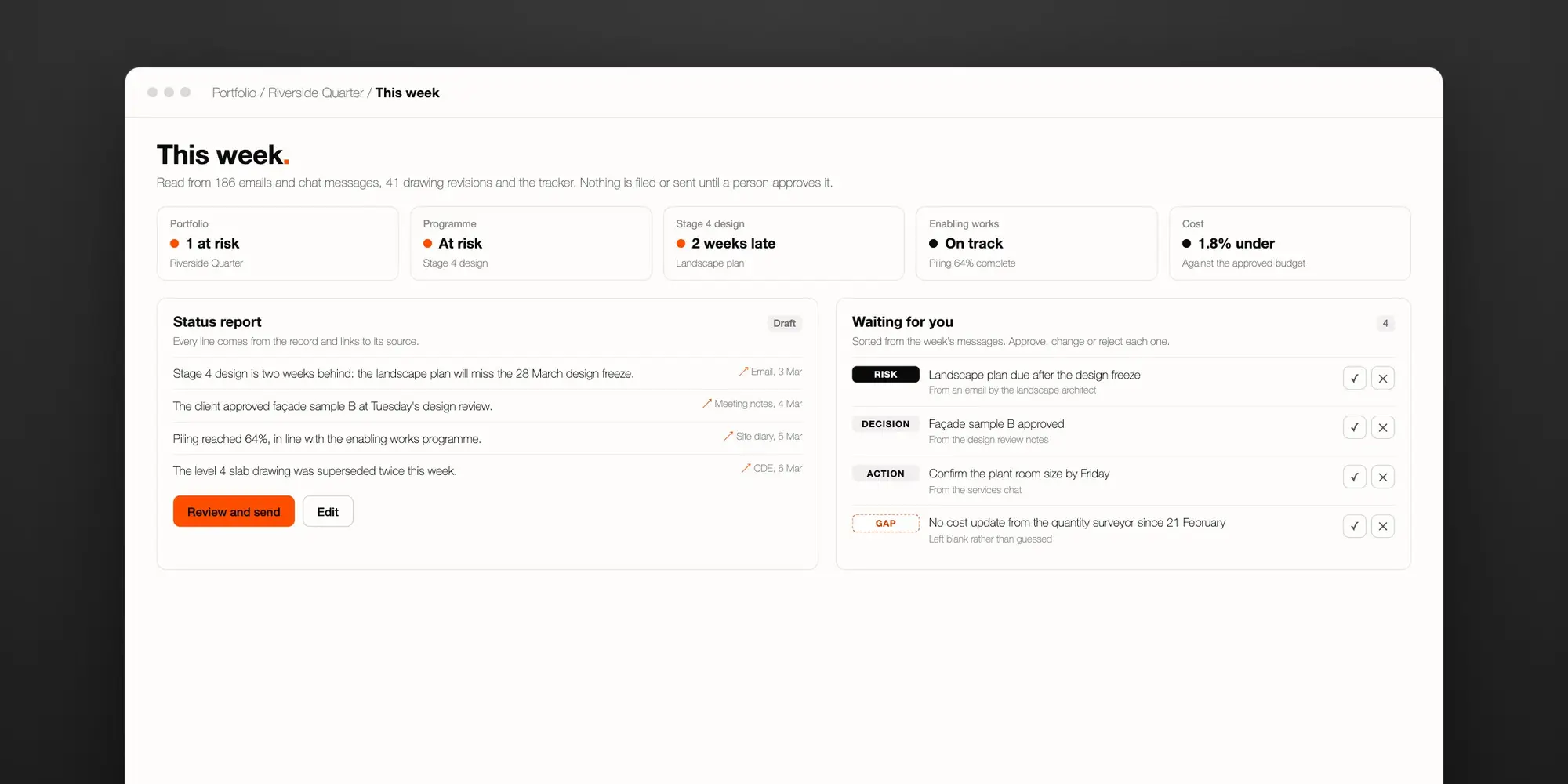
A project management office (PMO) is the team that sets how projects are run and keeps the record of how they are going: the methods, the plans, the reports, and every risk, issue and decision. Artificial intelligence (AI) changes the record-keeping most. It reads the work as it happens, so people spend their time on judgement, not on chasing updates.
This guide covers what a PMO does, the kinds there are, when one is worth having, and where AI earns its place in project management.
What a project management office does
A PMO doesn’t deliver the project. The project teams do that. The PMO makes delivery visible and governed, so the people paying for the work know where it stands and can decide on evidence.
Most PMOs do some mix of six jobs.
- Standards. One way of planning, reporting and running projects, with the templates and methods to match.
- Planning and scheduling. Joining up the plans of every team and supplier, so a delay in one shows its effect on the others.
- Reporting. A regular, honest view of progress, cost and risk for the people who sponsor the work.
- Governance. Who decides what, and when: stage gates, change control and escalation paths.
- Risks, issues and decisions. The register of what could go wrong, what has gone wrong, and what was decided about it. Many teams call it the RAID log, for risks, assumptions, issues and dependencies; others track actions and decisions in the same place.
- Suppliers and people. Coordinating consultants, contractors and vendors, and the staff shared between projects.
The weight shifts with the work. A software programme leans on planning and release governance. A building project leans on cost, change control and the document record.
Project, programme and portfolio PMOs
PMOs are usually named by the level they work at.
- A project office supports one large project. It’s often set up for that project and closed when it ends.
- A programme office coordinates several related projects that share one outcome. The Smart Services PMO ddx ran at One Bangkok for Hitachi Asia was one: 22 work packages and around 120 people under one governance structure.
- A portfolio office sits across an organisation. It helps the leadership choose which projects to run, then tracks whether they deliver what was promised. Some organisations call it an enterprise PMO.
In the UK, the P3O guidance (portfolio, programme and project offices) works with the same three levels.
Supportive, controlling and directive
The other way to describe a PMO is by how much control it has. PMI (the Project Management Institute) describes three types in its PMBOK Guide (A Guide to the Project Management Body of Knowledge).
- Supportive. The PMO offers templates, training and lessons from past projects. Project managers choose whether to use them. Low control.
- Controlling. The PMO sets the methods, templates and reporting, and checks that projects follow them. Moderate control.
- Directive. The PMO runs the projects itself, and project managers report to it. High control.
No type is better in general. A supportive PMO suits experienced teams doing familiar work. A directive one suits a programme where several organisations meet with no shared way of working, and someone has to set the rules.
On property and infrastructure projects, one more question matters: whose side the PMO is on. An owner-side PMO works for the client, not the contractor, and gives the owner its own view of cost, schedule and risk. On US projects that role is often called an owner’s representative; in the UK, client-side project management.
When a PMO is worth having
Not every project needs one. These are the usual signs that an organisation or programme does.
- Several projects compete for the same people, and nobody can see the whole picture.
- Status reports from different teams don’t agree, or all say green until the week something turns red.
- Decisions get made twice, because nobody can find when, or why, they were made the first time.
- Several suppliers each bring their own plan and their own reporting.
- A board or funder wants one view of progress, and putting it together takes days.
Setting one up
- Start with the decisions it has to support. Who decides what, how often, and on what evidence. The reports follow from that, not the other way round.
- Find out where things stand. Before the One Bangkok PMO was deployed, ddx ran a discovery phase on the status of the existing work packages, the dependencies between them and what each stakeholder expected.
- Choose the level and the type. Project, programme or portfolio; supportive, controlling or directive.
- Hire for the gaps. At One Bangkok the core team was a project director, a system architect, a devices and sensors engineer, a senior scheduler and a systems integration project manager: the skills that programme lacked.
- Agree the rules early. Roles, communication and escalation, settled before the first crisis tests them.
- Decide where the record lives. And make it come from the work itself, not from someone’s evenings.
A PMO can be staffed from inside the organisation or bought in, which some firms sell as PMO as a service. Buying in suits a programme with a fixed end, or an organisation without the specialists. The risk is that the knowledge leaves with the supplier, so plan the handover from the start: design the structure, recruit the people to run it, and stay until it runs without you.
What makes a PMO work
Structure and people come first. At One Bangkok, three organisations that had never worked together at that scale shared one programme. The PMO had to define the rules of engagement, role boundaries, communication protocols and escalation paths while managing live delivery at the same time. The lesson we took from it: no technical solution, however well designed, compensates for weak governance or an unclear team structure.
The record comes second, and it’s where most PMOs struggle. The tracker is the smallest part of a project’s record. The real history sits in email, chat threads, drawing revisions and supplier replies, which the management tools never see. A status report written by hand after the fact keeps the conclusion and loses the evidence. Years later, when a claim arrives, the answer can depend on finding someone who remembers.
That second problem is where AI helps most.
Where AI fits in project management
“AI project management” covers two different things. One is AI features inside a scheduling or task tool: a suggested deadline, a summarised ticket. The other is AI that reads the project’s own traffic and keeps the record. The second changes a PMO’s work far more.
What AI does well.
- Reading the traffic. It reads email, chat, the work tracker and documents, and sorts what it finds into risks, issues, decisions and actions, each linked back to the message it came from.
- Drafting the report. A status report can assemble from that record, every line traceable to its evidence. The prose is generated; the facts are not.
- Rolling up health. Health can be computed from the work itself, from project to programme to portfolio. One red project turns its programme red, and the portfolio shows which one.
- Finding gaps. Where the record is missing something, it says so, rather than filling the gap with something plausible.
What stays with people.
AI handles the volume, our team brings the judgement. In practice that means three things. Uncertain entries, and anything a supplier submits, wait for a person to approve them. A drafted report is a draft: nothing is filed or sent until a person decides it should be. And the decisions themselves, on scope, money and people, stay with the people accountable for them.
What to watch for.
- Invented content. A tool that fills gaps with plausible text is worse than no tool. Where the evidence isn’t in the text, the field should stay blank.
- Data. Project traffic carries client and supplier information. Decide which tools may see it before anyone pastes it in.
- Accountability. Someone has to own every output. “The AI wrote it” is not an answer a sponsor will accept.
The PMI standard for AI
In June 2026, PMI published The Standard for Artificial Intelligence in Portfolio, Program, and Project Management, which it describes as the first global standard for applying AI in project work. It sets out eight guiding principles, five performance domains and a life cycle for designing, deploying and overseeing AI, with human-in-the-loop practices for reviewing and acting on what AI produces.
ddx runs a governed practice to the PMI Standard for AI in portfolio, programme and project management, with a documented playbook covering every team. Every AI tool we use sits under one framework. A named person owns every output, and nothing AI produces reaches a client until they’ve approved it. Client data goes only into approved tools. Everyone at ddx is tested on the framework every year.
The ddx AI Audit, our two-week review of the AI an organisation is running, is scored against the same standard.
How ddx runs PMOs
As a practice. For Hitachi Asia, ddx recruited and ran the Smart Services PMO at One Bangkok: around 120 people across 22 work packages. That work led TCC Technology to appoint ddx as its direct smart services delivery partner, through to One Bangkok’s opening in October 2024. For Marriott International, ddx is the owner-side design and PMO governance layer on the renovation of a flagship hotel in Tokyo, with a project management framework aligned with PMI across governance, scope, risk, procurement and delivery, and formal change control. Read more about our Delivery practice.
As a platform. ddx PMO reads the email, chat, work-tracker and document traffic a project already produces, and builds one live project record from it: each risk, issue, decision and action, linked back to its source. Status reports follow PMBOK, ISO 19650 or Agile. Documents and drawings sit in a common data environment, with controlled revisions and transmittals to suppliers. Its own site is ddxpmo.com.
We built it after running programme governance at the scale of One Bangkok, where the real record of what happened lived in email, chat and drawing revisions rather than in the tracker. We’re our own first client: ddx PMO runs on ddx’s own live engagements first, so by the time it reaches clients it’s already proven on real work.