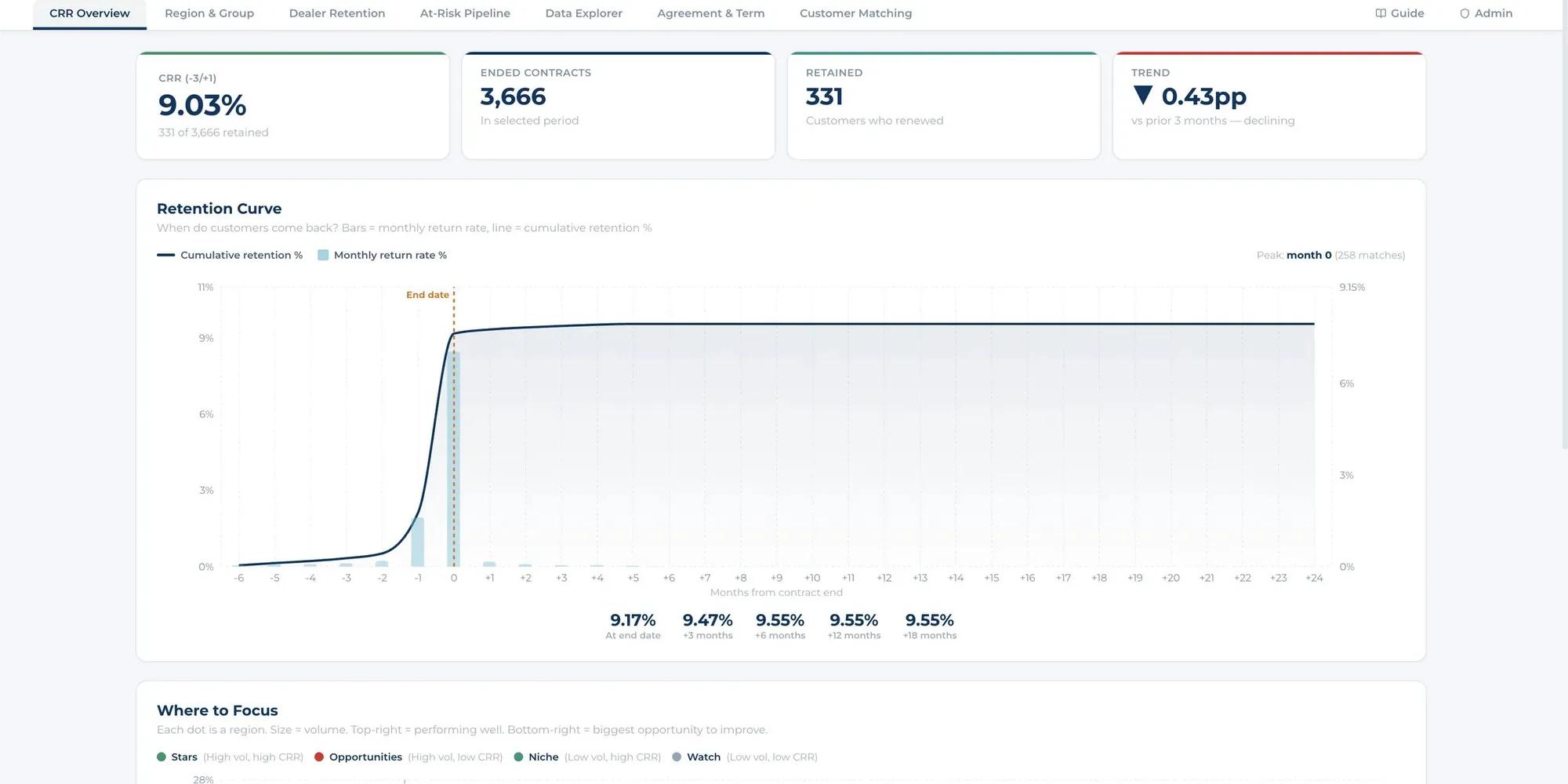
Motor finance lenders run on three numbers: new business, arrears and retention. The first two are measured to the basis point. Retention is usually a guess.
That matters, because retention is where a great deal of the value sits. The financial impact of customer retention set out the arithmetic: on a representative book of 100,000 contracts, one more percentage point of retention adds roughly €28m a year. But a lender can’t move a number it can’t see. This piece is about seeing it.
Why the number is missing
Contract systems are built around agreements, not people. Every new agreement creates a new customer number, and when a contract ends, the customer drops out of view.
So someone financing their third car looks the same as a first-time buyer. Loyalty is invisible, and repeat business goes unrecognised.
Start with the customer, not the contract
The first step is to link every contract to a real person. Most books have no unique customer ID to do it with, so the match has to be built from several signals at once: bank details, name, phone number, postcode and links between members of a household.
It also has to cope with the mess in real data: misspelt names, shared households, people who have moved or changed their number. Matching on name and date of birth alone misses more than 40% of real matches.
In one pilot, 52,795 contracts resolved to 51,225 unique customers. Counting contracts instead counts some people twice, and the rate built on it is wrong from the start.
Use one definition
With customers resolved, retention can be measured the same way everywhere. The customer retention rate (CRR) is:
CRR = renewed contracts ÷ ended contracts × 100
A contract counts as renewed when the same customer takes out a new agreement within a set window after it ends. The window can be one, three, six or twelve months. Six is our default.
Run the same definition across hire purchase (HP), personal contract purchase (PCP), lease and personal loan, and the products can be compared for the first time.
The comparison is where the surprises are. In pilot data, PCP customers renewed at nearly double the rate of HP customers. Customers who ended their agreements early renewed at far higher rates than those who ran to full term. The pilot above put its national six-month CRR at 4.59%: the honest baseline any improvement is measured from.
Split the headline by dealer
A single national rate hides who keeps the customer.
A customer who renews through a different dealer still counts as retained for the lender. For the first dealer, they’re gone. Separating customers who came back through the same dealer from those who came back through another one shows the churn inside the network: which dealers keep their customers, and which lose them to other dealers in the network.
The rate should drill down the way the business is run: national, then region, dealer group and dealer.
Then look ahead
A measured rate becomes a list of work. Every contract coming up to the end of its term can be scored and ranked, so the team acts before the customer walks.
When to act is covered in The financial impact of customer retention: at six, three and one months from maturity, before a rival’s quote lands. Data alone renews nothing; people close renewals. Your next sale is already in your CRM covers that half.
What it takes
The starting point is a standard extract from the loan-management system: names, addresses, phone numbers, bank details and agreement dates, sent over an encrypted file share. Nothing changes in the core or customer-facing systems, and the analysis can run in the cloud or on the lender’s own servers where data has to stay in the country.
The first true retention rate arrives two weeks after the extract. Matching customers across the full book takes about five working days. A full dashboard follows by week four, and live data feeds with single sign-on by week eight.
Where this comes from
RetainIQ, part of MobilityIQ, does this measurement. It began as a reporting tool we built in four weeks for a UK motor finance company, starting from an anonymised data extract and deployed on the client’s own servers. The same approach now runs on any motor finance book.
Read more about MobilityIQ.