A smart building is one whose systems share data and act on it. Heating and cooling, lighting, access, lifts, security and energy meters are connected, so the building can run more efficiently, respond to the people inside it, and tell its operator what is happening. Devices alone don’t make a building smart. Integration does.
Most new commercial buildings already have plenty of technology. Many still aren’t smart, because each system runs on its own: the lighting doesn’t know the room is empty, the air conditioning doesn’t know the meeting was cancelled, and the operator checks five screens to find one fault.
The five layers of a smart building
It helps to think of smart building technology as five layers, each depending on the one beneath it.
- Connectivity. The networks everything runs on: fibre into the building, Wi-Fi, mobile coverage, and the networks that carry sensor data. Without it, nothing else works.
- Systems and devices. The building management system (BMS), which runs heating, ventilation and air conditioning (HVAC); lighting; access control; cameras; lifts; energy and water meters; and sensors for occupancy, temperature and air quality.
- Integration. The layer that lets those systems exchange data and commands, with one way of naming every device and space. On larger buildings and districts this is the job of a master systems integrator.
- Applications. What people actually use: the operator’s dashboards, fault detection and maintenance planning; and for occupiers, access by phone, room booking, visitor registration and wayfinding.
- Operations. The team and the processes that act on what the data shows. A building whose alerts nobody reads is not smart.
The layers explain why adding devices rarely makes a building smarter. A new sensor is only useful if its data reaches a system that can act on it, and a person who is responsible for the result.
What a smart building does, and for whom
The same building does different things for each of the people who depend on it.
- Owners and developers get lower running costs, mainly through energy, a building that is easier to let, and data about how the asset is really used.
- Operators and facilities teams get one view of every system, faults found before occupiers report them, and maintenance planned from the equipment’s condition rather than the calendar.
- Occupiers and visitors get comfort, easy access and services that work: the lift arrives, the room is cool, the booking holds.
None of this needs a building to have every system on the market. It needs a clear idea of what the building is for, and the systems chosen to do it.
Smart, intelligent or connected?
The terms overlap. “Intelligent building” is the older of the two main terms and is often used to mean the same as “smart building”. “Connected building” usually means the first layer only: a building with good digital connectivity, whether or not its systems share data.
Two certifications separate the ideas cleanly. WiredScore rates a building’s digital connectivity. SmartScore rates its smart technology and what that technology does for the people in it. Read WiredScore and SmartScore explained.
The downsides, and how to avoid them
Smart buildings bring risks that ordinary buildings don’t. Each can be designed out, but only if someone plans for it.
- Cybersecurity. Every connected device is a way in. Networks need dividing so that a compromised camera can’t reach the building controls, and the systems need patching for as long as they run.
- Data privacy. Access logs, cameras and occupancy sensors collect personal data. At One Bangkok, the platform had to comply with Thai data privacy law and international standards from the start.
- Lock-in. A building whose systems only talk through one vendor’s software is hard to change. A vendor-neutral integration layer avoids that.
- Technology bought before the need. Systems chosen from a catalogue, rather than from the uses the building has to serve, cost money and add complexity without adding much.
- Systems age faster than buildings. Controllers and software will be replaced several times in a building’s life. Open protocols and documented interfaces make that a replacement, not a rebuild.
- An operator who isn’t ready. The best-integrated building fails if the team that inherits it can’t run it.
Design it in, before procurement
Most of the decisions that make a building smart are made before any system is bought: what the building has to do, how the systems will connect, what every vendor has to provide, and which certifications to aim for. After procurement, each of those becomes a change.
That was the lesson of One Bangkok. A vendor-neutral integration layer, committed to before procurement begins, removes the most persistent source of lock-in. It is far harder to retrofit than to design in from the start.
At One Bangkok
One Bangkok is a mixed-use district of 1.8 million square metres in Bangkok, with more than 250,000 Internet of Things (IoT) sensors across the site. ddx designed and delivered the integration framework for its smart services, working for TCC Technology, the smart services subsidiary of the developer, TCC Group.
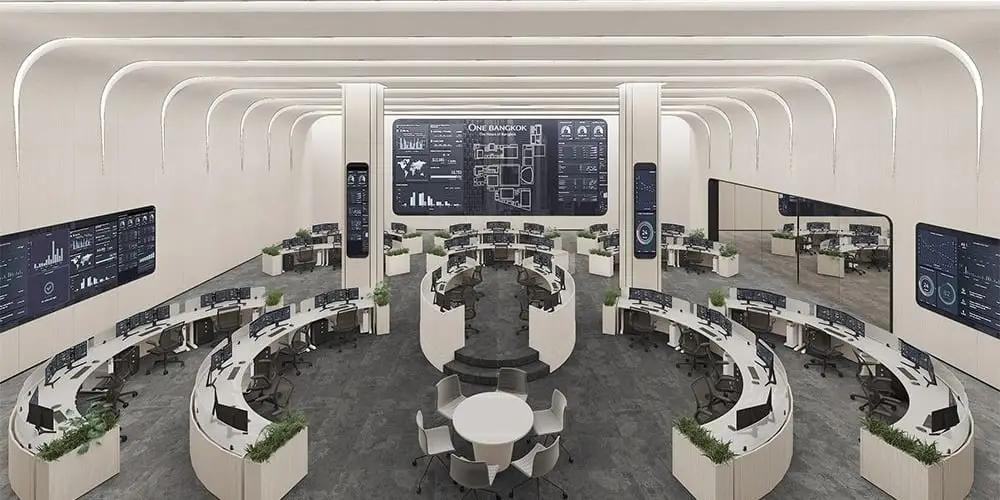
A central, vendor-neutral platform connects more than 30 operational and IoT systems, across energy, water, security, mobility and building management. It was live at opening in October 2024, giving the district’s command centre real-time visibility across all of them, and designed so that One Bangkok’s own team could run it from day one. Before that, ddx sourced and managed the Smart Services project management office (PMO) for Hitachi Asia, across 22 work packages.
One Bangkok received WiredScore and SmartScore Platinum certifications at launch. Pawel Michalski, who leads ddx’s real estate work, holds accredited professional credentials for both schemes. Read the One Bangkok case study.
Questions to ask at the start
- What must this building do for its owner, its operator and the people in it?
- Which systems does that need, and which can wait?
- How will the systems connect, and who owns the integration?
- What will every vendor have to provide before it is contracted?
- Which certifications, if any, are worth aiming for?
- Who will run the building’s technology after opening?
For what happens to a smart building’s data once it is integrated, read digital twins for buildings and districts.
ddx helps owners answer these questions through its smart building consultancy.