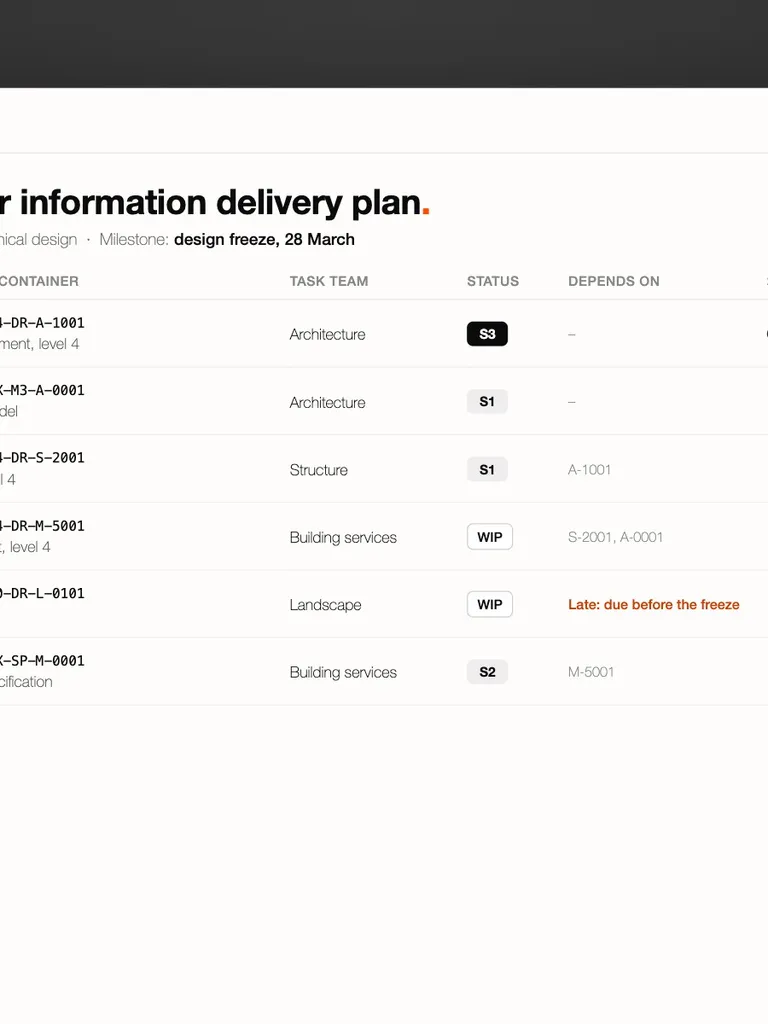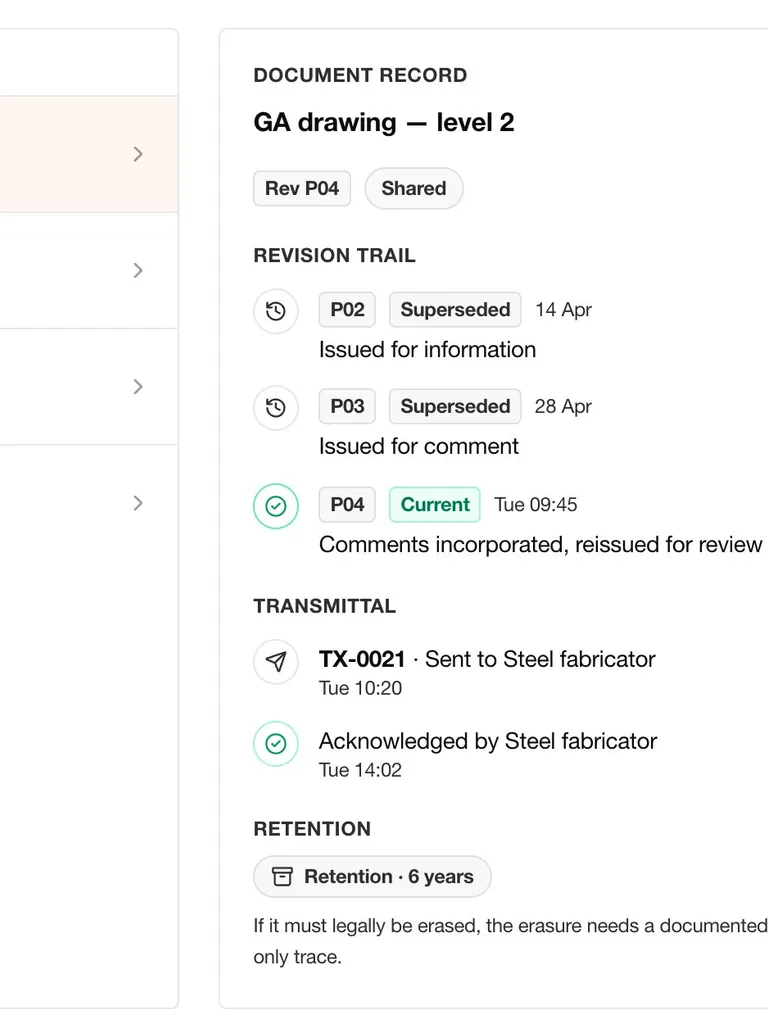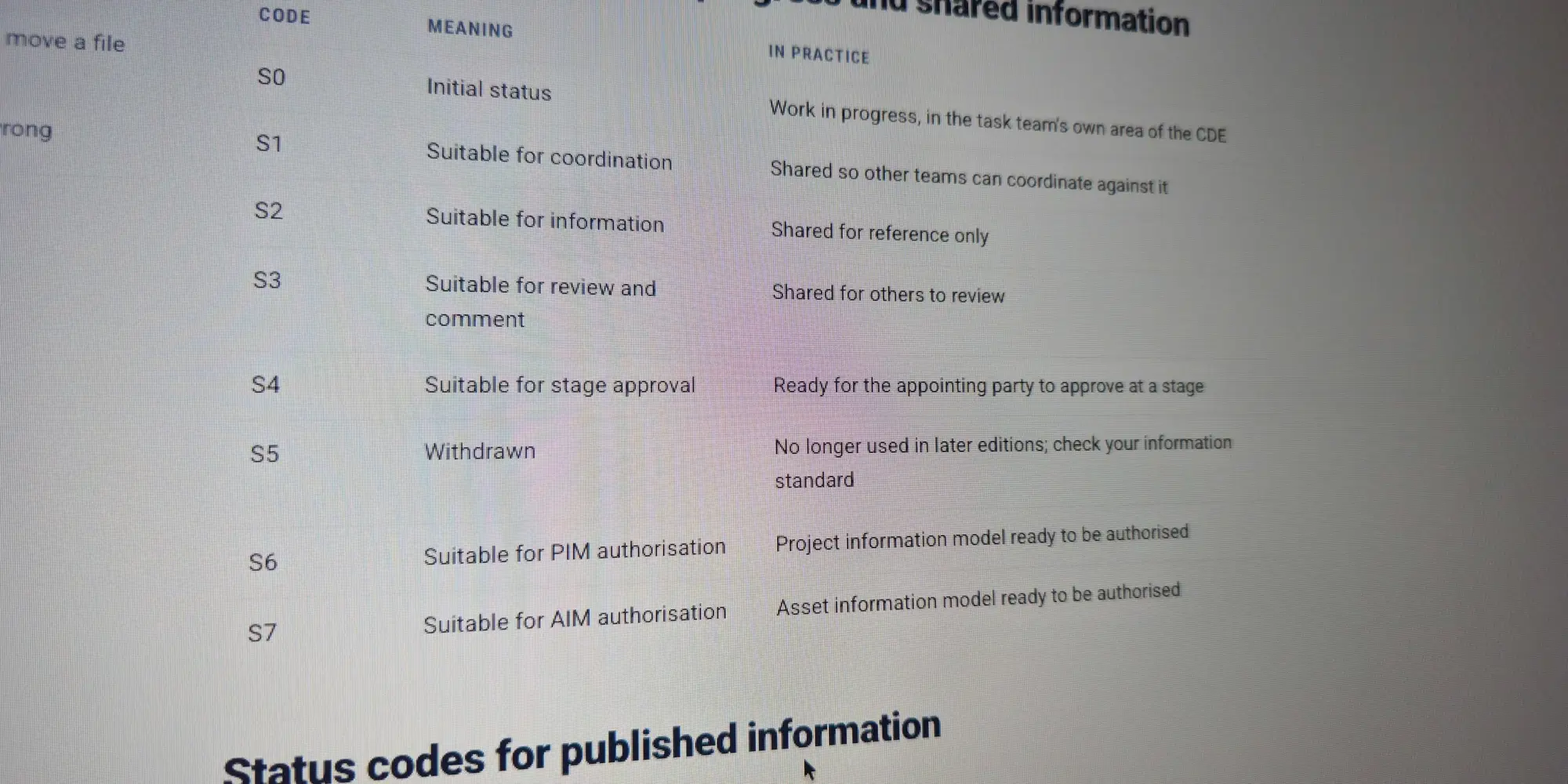
The ISO 19650 naming convention gives every file on a project one unique name, built from fixed fields separated by hyphens: project, originator, volume or system, level or location, type, role and number. Status codes travel with the name and say what the file may be used for, such as S1 for coordination. Revision codes say which version it is.
ISO 19650-2 requires every project to agree a convention like this, but leaves the fields open. The UK National Annex to BS EN ISO 19650-2 fills them in, and projects well beyond the UK borrow it. This guide follows the UK annex. For where naming sits in the client’s wider duties, read our guide to ISO 19650 for clients.
The seven fields
A name under the UK annex looks like this:
HTL-ABC-ZZ-01-DR-A-0001
Read left to right, it’s a drawing (DR) by the architect (A) of firm ABC, for the first floor (01) across every block of the hotel project HTL, numbered 0001.
| Field | What it says, and its length | In the example |
|---|---|---|
| Project | The project’s code, the same on every file: 2 to 6 characters | HTL |
| Originator | The firm that produced the file: 3 to 6 characters | ABC |
| Volume or system | The part of the project, such as a building, a zone or a system: 1 or 2 characters | ZZ, all of them |
| Level or location | The floor or location: 2 characters | 01, the first floor |
| Type | The kind of information: 2 characters | DR, a drawing |
| Role | The discipline that produced it: 1 or 2 characters | A, the architect |
| Number | A sequence number within the other fields: 4 to 6 digits | 0001 |
Two codes do a lot of work in the middle fields: ZZ means the file covers several volumes or levels, and XX means none applies.
The project sets its own codes for each field, within those rules, in its information standard. The annex gives the standard codes for type and role. A few common ones:
| Type | Meaning | Role | Meaning |
|---|---|---|---|
| DR | Drawing | A | Architect |
| M3 | 3D model | C | Civil engineer |
| SP | Specification | E | Electrical engineer |
| SH | Schedule | M | Mechanical engineer |
| RP | Report | S | Structural engineer |
| CA | Calculations | K | Client |
| RI | Request for information | W | Contractor |
What isn’t in the name
The status and the revision aren’t part of the name. They’re metadata: information the common data environment holds about the file, alongside it.
That’s deliberate. A file changes status several times in its life. If the status were in the name, every change would mean renaming the file, breaking every link to it and leaving copies under old names. Keeping the name fixed means a drawing is the same drawing from its first sketch to the archive.
Status codes
The status code, sometimes called the suitability code, says what a file may be used for. It follows the four states of the common data environment: work in progress, shared, published and archived. The UK annex’s codes, in short:
| State | Code | Suitable for |
|---|---|---|
| Work in progress | S0 | Initial status: still being worked on inside the task team |
| Shared | S1 | Coordination with other task teams |
| Shared | S2 | Information only |
| Shared | S3 | Review and comment |
| Shared | S4 | Stage approval |
| Shared | S6 | Authorisation of the project information model |
| Shared | S7 | Authorisation of the asset information model |
| Published | A1, A2, A3… | Authorised and accepted, at the stage the number denotes |
| Published | B1, B2, B3… | Partially accepted, with comments to resolve |
| Published | CR | As-constructed record |
The line between shared and published matters most. Shared information is for the team to work with. Published information has been authorised by the lead appointed party and accepted by the client, and only then is it for construction, a contract or handover. Building from a file at S2 is building from information, not from an instruction.
Revision codes
The revision code says which version of the file this is. The UK annex splits revisions in two:
- Preliminary revisions. P01, P02 and so on, while the file is being developed and shared. Versions inside work in progress add a decimal: P01.1, P01.2.
- Contractual revisions. C01, C02 and so on, once the file is published.
So a drawing might go through P01.1 and P01.2 inside the task team, be shared as P01 for coordination, come back as P02 after comments, and be published as C01 once it’s authorised and accepted.
Why it matters to the client
Naming and codes look like the design team’s housekeeping. They matter to the client for four reasons.
- One name, one file. The same drawing can’t sit in the record under two names, so nobody works from the wrong one.
- Checks a system can make. A common data environment can reject a file whose name breaks the convention, instead of someone finding out months later.
- Clear use. The status code says, on the file, whether it can be built from. Disputes about which drawing was “for construction” get shorter.
- A findable handover. The asset information model the owner keeps for decades is only as searchable as the names in it.
The delivery plans use the same names. Each row in a TIDP or MIDP names the file it promises, so a plan can be checked against what actually arrives. Our guide to delivery plans explains them.
Projects outside the UK
ISO 19650-2 only requires a convention, with fields and a separator, agreed for the project. Many clients in Europe, the Gulf and Asia adopt the UK annex’s fields and codes as they are; others add a field, for a plot or a phase, or set their own codes. Either works, as long as the client sets it out before appointments and every firm follows it.
In ddx PMO, our project management office (PMO) platform, names are built from the fields rather than typed, and checked on upload.
Questions people ask
What are suitability codes?
Another name for status codes. The code is the status; the description, “suitable for coordination”, is its suitability.
What does S2 mean in ISO 19650?
Suitable for information. The file is shared for the team to read, not to coordinate against, comment on or build from.
What’s the difference between a status and a revision?
The status says what a file may be used for. The revision says which version it is. Both are held with the file, and both change as it moves through the common data environment.
Do file names have to follow the UK annex?
Only where the project requires it. ISO 19650 asks for a consistent convention; the UK annex is the most widely used one.