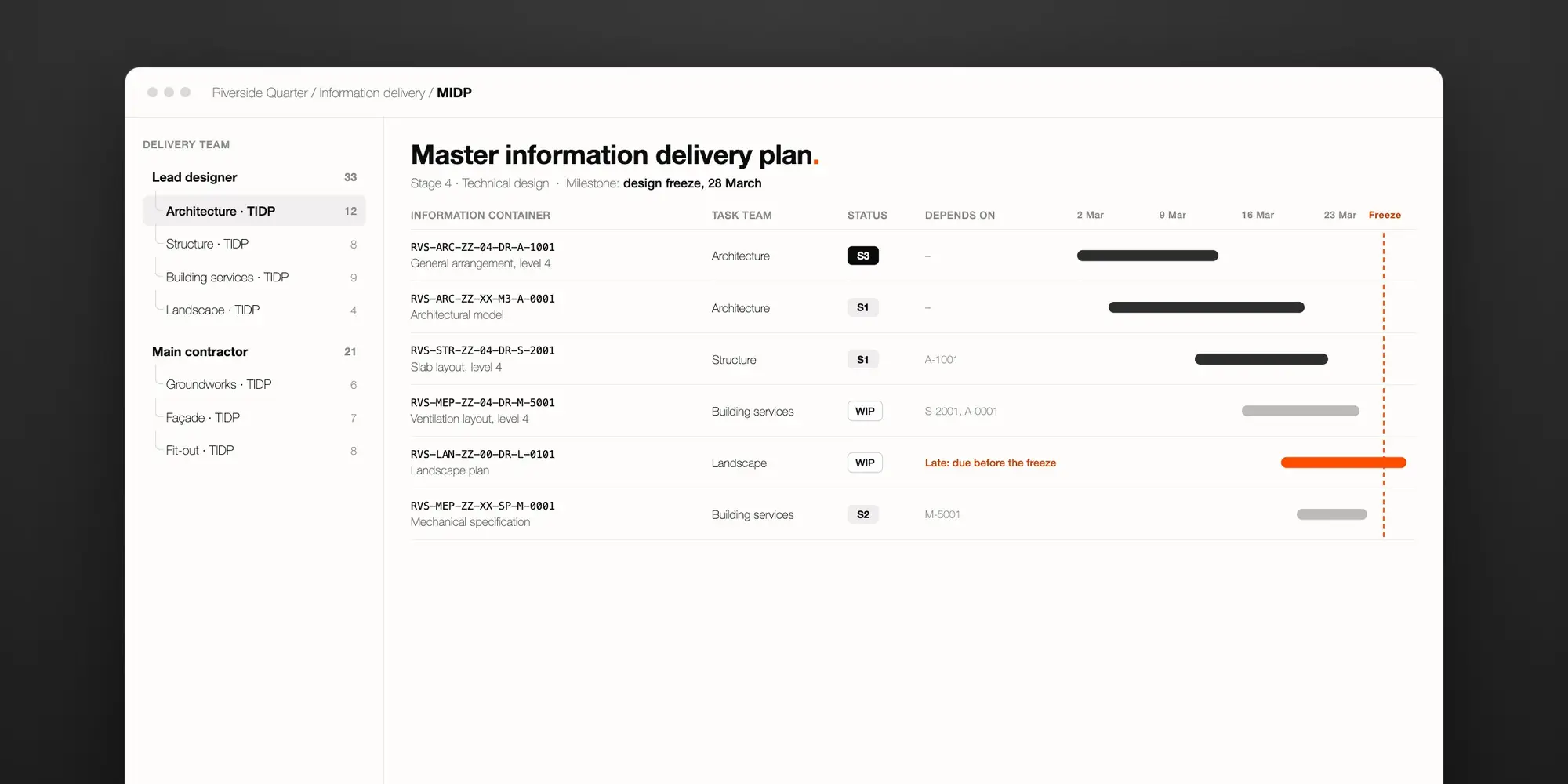
A TIDP, or task information delivery plan, lists the information one task team will produce on a project, and when. A MIDP, or master information delivery plan, brings every TIDP in a delivery team together into one schedule, aligned with the project programme. Both come from ISO 19650-2, the international standard for managing information during design and construction.
Where they fit
ISO 19650 starts with the client. The client, which the standard calls the appointing party, writes down what information it needs from each firm it appoints, in its exchange information requirements (EIR). Our guide to ISO 19650 for clients covers that side.
The firms answer as a delivery team: a lead appointed party, such as the lead designer or the main contractor, with the firms it appoints beneath it. Within the team, each task team does one piece of work, such as the architecture, the structure or the building services.
The delivery team’s answer comes in two parts. The BIM execution plan (BEP) says how the team will work. The delivery plans say what it will produce, and when. That’s where the TIDP and the MIDP come in.
Both plans are lists of information containers. An information container is any named piece of information that can be stored and found again: a drawing, a model, a specification, a schedule, a report.
What goes in a TIDP
Each task team writes its own TIDP. It usually holds one row per information container, with:
- The container’s name, using the project’s naming convention, so the plan can be checked against what actually arrives;
- A title, in words a person can read;
- The level of information need: how much detail the container holds, and what it’s for;
- Who produces it within the task team;
- When it’s due, against the project’s information delivery milestones;
- How long it takes to produce;
- What it depends on: information from other task teams that has to arrive first.
ISO 19650 doesn’t fix a template. Most projects set one in the EIR or the BEP, and most use a spreadsheet with a row per container.
What a MIDP adds
The lead appointed party combines every TIDP in its team into the MIDP. Putting them together does four things a set of separate lists can’t.
- One schedule. The whole delivery team’s information on one timeline.
- Aligned with the programme. Each delivery is set against the project programme and the client’s milestones, so information arrives when the decision that needs it is due.
- Dependencies across teams. Where the services engineer needs the architect’s layouts first, the MIDP shows it, and shows the knock-on if they’re late.
- Risks in view. Where a task team can’t deliver in time, the MIDP is where it shows first.
The MIDP is a living plan. The lead appointed party keeps it current as the project moves, and it forms part of what’s agreed at appointment.
MIDP and TIDP side by side
| TIDP | MIDP | |
|---|---|---|
| Stands for | Task information delivery plan | Master information delivery plan |
| Written by | Each task team | The lead appointed party |
| Covers | One task team’s information | The whole delivery team’s |
| Built from | The task team’s scope | Every TIDP in the delivery team |
| Aligned with | The task team’s own programme | The project programme and the client’s milestones |
| Read by | The task team and the lead appointed party | The lead appointed party and the client |
Where the BIM execution plan comes in
The BEP is about how; the MIDP is about what and when. The BEP sets out the team’s information management roles, how models will be combined, the software and file formats, and how information will be checked before it’s shared. A first version goes in with the tender, so the client can judge whether the team can do the job. After appointment, the team confirms the BEP and produces the detailed delivery plans.
What the client should check
The client doesn’t write the MIDP, but it should read it closely. Five things to check:
- Every requirement is planned. Each item in the EIR appears in the MIDP, against a milestone.
- The dates match the programme. The MIDP’s dates line up with the programme the design team or contractor is actually working to.
- The names follow the convention. Then the plan can be checked automatically against what arrives in the common data environment.
- The dependencies are named. Which task team needs whose information first, and what happens if it’s late.
- It’s kept current. A MIDP agreed at appointment and never updated is a record of intentions, not a plan.
The last check is where most projects slip. A plan kept in a spreadsheet drifts away from what’s actually in the common data environment. The better arrangement is to check the plan and the record against each other: every planned container has either arrived, at the right status and by its date, or shows as late.
Questions people ask
What does MIDP stand for?
Master information delivery plan: the combined plan for all the information a delivery team will produce.
What does TIDP stand for?
Task information delivery plan: one task team’s plan for the information it will produce.
Is a MIDP the same as the project programme?
No. The programme schedules the work; the MIDP schedules the information. They should agree with each other, and the MIDP’s dates should come from the programme.
Who approves the MIDP?
The lead appointed party compiles it and is responsible for it. The client reviews it and agrees it as part of the appointment.