ISO 19650 is the international standard for managing information over the whole life of a building or piece of infrastructure, using building information modelling (BIM). It sets out who asks for what information, when, in what form, and how it’s checked, shared and kept, from the first brief to decades of operation.
Most guides to it are written for design teams and BIM managers. This one is for the client: the owner, developer or operator, which the standard calls the appointing party. ISO 19650 puts more on the client than many clients expect. If the client doesn’t say what information it needs, nobody else can deliver it.
The six parts
ISO 19650 comes in six parts. Each one covers a stage of an asset’s life, or a concern that runs across all of them.
| Part | What it covers | When it applies |
|---|---|---|
| 1 (2018) | Concepts and principles: the vocabulary, the information requirements and models, the common data environment | Throughout |
| 2 (2018) | The delivery phase: managing information while an asset is designed and built | From brief to handover |
| 3 (2020) | The operational phase: managing information while an asset is in use | From handover, for the life of the asset |
| 4 (2022) | Information exchange: how information is checked and accepted when it passes between parties | At every exchange, in both phases |
| 5 (2020) | Security: protecting sensitive information about an asset | Throughout, in proportion to how sensitive the asset is |
| 6 (2025) | Health and safety: collecting and sharing health and safety information | Throughout |
Parts 1 and 2 are what most projects mean when a contract says “work to ISO 19650”. Part 3 matters to any owner who will run the building afterwards. Part 5 is the one most often skipped.
In the UK, the standard is published as BS EN ISO 19650, and part 2 carries a UK National Annex that fixes details the international text leaves open, such as the naming convention and status codes.
Who is who
ISO 19650 names parties by what they do in the flow of information, not by job title.
- Appointing party. The client: the organisation that receives information from the firms it appoints. Usually the owner, developer or operator.
- Lead appointed party. A firm appointed directly by the client that coordinates the information produced by its own team. Typically the lead designer or the main contractor. A project can have several.
- Appointed party. A firm appointed by a lead appointed party to produce information: consultants, specialists, subcontractors.
A lead appointed party and its appointed parties make up a delivery team. Within it, a task team is a group producing one piece of work, such as the structural design.
The client can have someone carry out its information management duties on its behalf, such as a project manager or an owner’s representative. The duties can be delegated. The responsibility for deciding what the client needs stays with the client.
What the client has to set out
Before anyone is appointed, part 2 expects the client to have decided a set of things. In plain terms:
- who manages information on the client’s behalf, in-house or appointed;
- what information the client needs, written as the requirements below;
- when it needs it: the information delivery milestones, tied to the project’s key decisions;
- the standards and methods everyone must follow: naming, classification, file formats, and how much detail each deliverable needs;
- the reference information everyone starts from: surveys, existing drawings and models, templates and object libraries;
- the common data environment, set up and ready before the first appointment;
- the information protocol: the terms on information that go into every appointment, such as licences to use it and liabilities.
The requirements themselves run in a chain, from the organisation down to each appointment:
- Organisational information requirements (OIR). What the organisation needs to know to run its business: its portfolio, asset management, reporting to regulators and funders. They belong to the client, not to any one project.
- Asset information requirements (AIR). What the organisation needs to know to operate and maintain this asset. They decide what’s handed over at the end.
- Project information requirements (PIR). What the client needs to know to take the project’s key decisions: whether to proceed, whether to approve a design, whether to release funds.
- Exchange information requirements (EIR). What each appointed firm must deliver, in what form, with how much detail and by when. They’re written for each appointment and go out with the tender.
The OIR feed the AIR and the PIR. The AIR and the PIR feed the EIR. The EIR are what the market prices.
A good set of requirements is short and specific. Each requirement answers a question someone will actually ask. “Room data for every guest room, in a schedule the operator’s maintenance system can import” is a requirement. “All information to be provided in BIM” isn’t. ISO 19650 talks about the level of information need: as much detail as the purpose requires, and no more. Good requirements are written with the people who’ll use the information, in operations, facilities and finance, not only with the design team. And they say how the client will check what it receives, which is what part 4 is for.
The plans the team gives back
The delivery team answers the requirements with plans of its own.
- BIM execution plan (BEP). How the team will meet the EIR: who’s responsible for what, how models will be combined, which software and formats it will use, and how information will be checked. A first version comes with the tender; a fuller one follows the appointment.
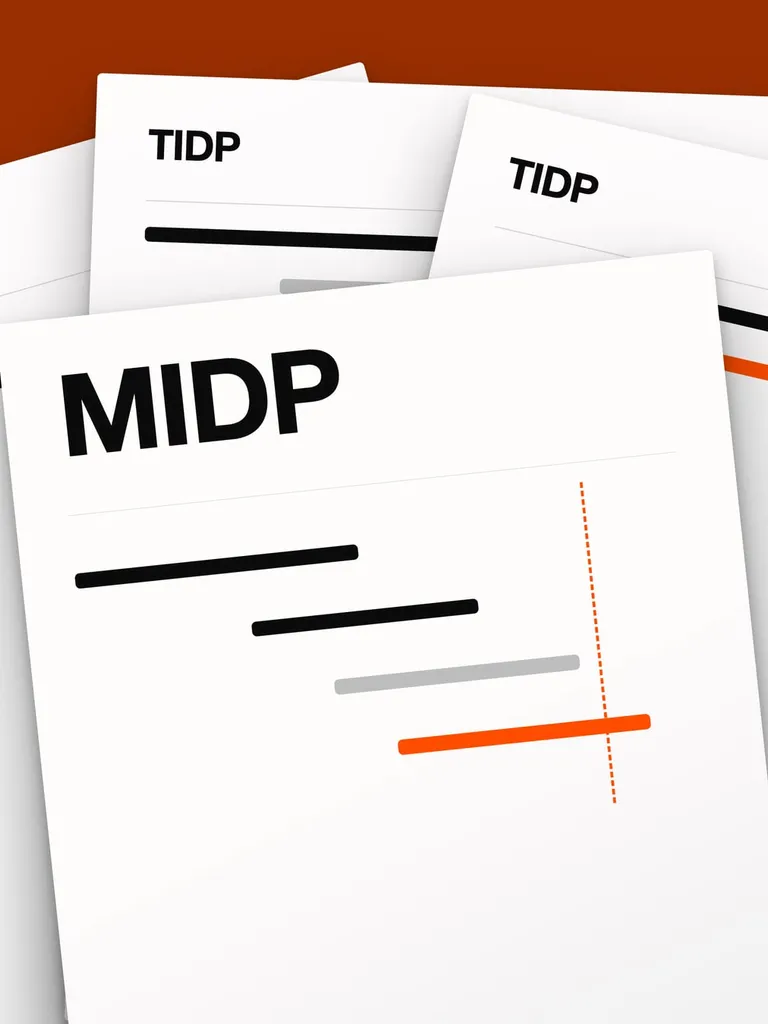
- Task information delivery plan (TIDP). Each task team’s list of the information it will produce, and when.
- Master information delivery plan (MIDP). The lead appointed party’s combination of every TIDP into one plan for the delivery team, aligned with the project programme.
The client doesn’t write these, but it should read them. The MIDP is where a client can see, line by line, whether what it asked for is actually planned. There’s more on MIDP and TIDP in our short guide.
The common data environment
The common data environment (CDE) is the agreed single source of information for the project. The standard describes it as a way of working before it’s a piece of software: the CDE workflow is the process, and a CDE solution is the technology that runs it. Under part 2, the client establishes it, before the tender.
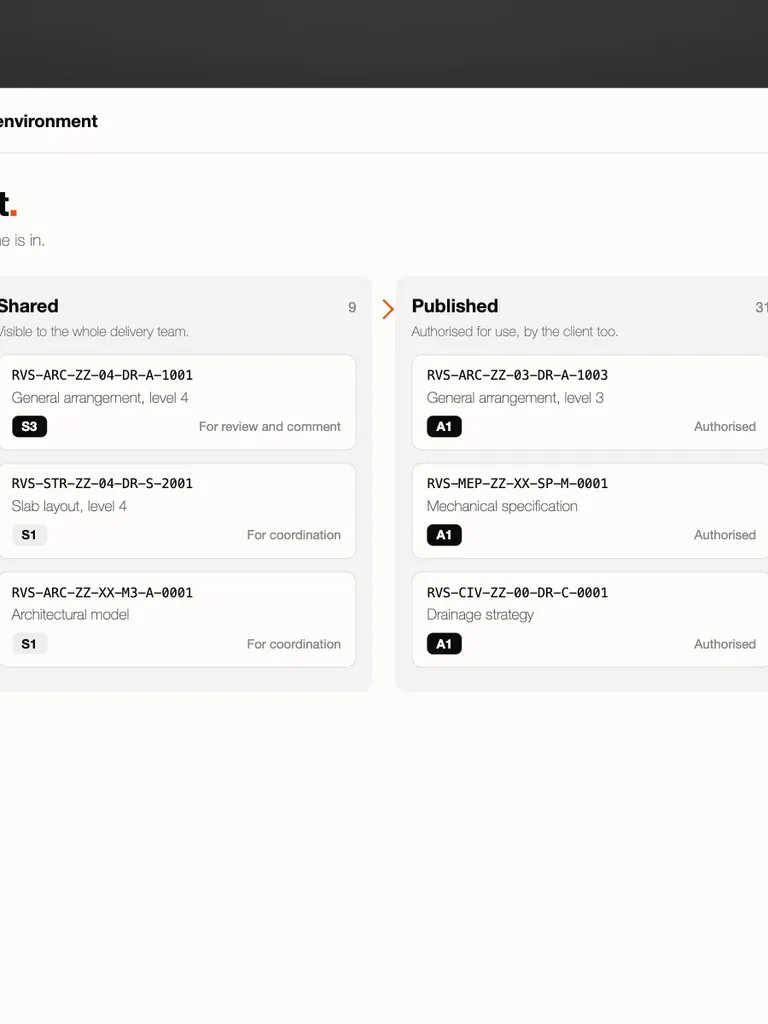
Every piece of information passes through four states:
- Work in progress. Inside the task team producing it, and not visible to anyone else.
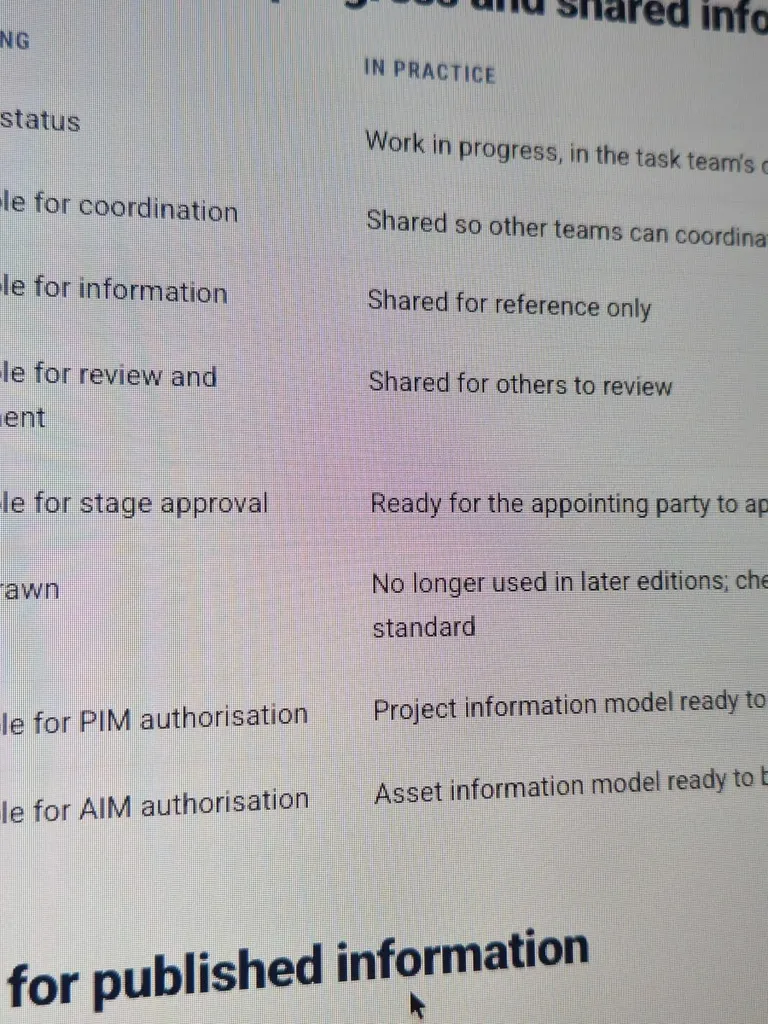
- Shared. Checked and released to the wider team, for coordination, comment or information. Not yet for use in construction.
- Published. Authorised by the lead appointed party and accepted by the client for use: for construction, for a contract, for handover.
- Archived. Superseded versions, and the record of every change of state, kept for the life of the asset.
Each file carries metadata that says what it’s suitable for, its status code, and which revision it is. Our guide to what a common data environment is goes further.
When information passes from one party to another, the issue should be recorded too: who was sent which revision, and when they acknowledged it. That record is a transmittal, and our guide explains transmittals.
Security: part 5
Part 5 asks the client one question first: is this asset, or the information about it, sensitive? A hospital, a data centre, a transport hub, a building used by well-known people or a district whose systems run critical services may be. Floor plans, security layouts and network diagrams can be useful to someone who means harm.
If the answer is yes, the client sets a security strategy and a security management plan, and writes security requirements into every appointment. If it’s no, the client records the assessment and moves on. The point is proportion.
Part 5 sits beside ISO 27001, the standard for an organisation’s information security management. ISO 27001 covers how one firm protects its information. ISO 19650-5 covers how everyone on a project protects information about the asset. We work to both.
Handover
During design and construction, information builds up in the project information model (PIM). At handover, the parts the owner needs to run the building move into the asset information model (AIM), as the AIR set out. Part 3 looks after the AIM from then on.
COBie, short for construction operations building information exchange, is a structured format for that handover: spaces, systems and equipment, with their maintenance data, in a form a facilities management system can import. It exists because handover used to mean boxes of manuals and drawings nobody could search. In the UK, COBie data became a standard requirement on central government projects.
In the UK, the Building Safety Act 2022 adds the golden thread of information: for higher-risk buildings, the duty to keep accurate, up-to-date digital information about how the building was designed, built and changed, from design through occupation. Working to ISO 19650 is a natural way to keep it.
BIM Level 2, PAS 1192 and national annexes
Before ISO 19650, UK projects worked to BS 1192 and PAS 1192-2, together known as BIM Level 2, which central government required on its projects from 2016. ISO 19650 parts 1 and 2 replaced them in 2018, and the UK now describes the approach as information management according to the UK BIM Framework rather than as a level. Most of the ideas carried over; some names changed. Employer’s information requirements became exchange information requirements, for example.
Outside the UK, the standard is adopted nationally, as EN ISO 19650 across Europe, and many clients in the Gulf and Asia name it directly in their contracts. Projects there often borrow the UK annex’s naming and status codes with it.
How we work to it
We work to ISO 19650 on the projects we run for clients. We built it into ddx PMO, our project management office (PMO) platform, too. Drawings and documents sit in a common data environment inside a single project record. They move through the four states, carry names built from fields and checked on upload, and go to suppliers on numbered transmittals, which suppliers acknowledge in a portal of their own.
Questions people ask
What is the latest version of ISO 19650?
There are six parts: parts 1 and 2 from 2018, parts 3 and 5 from 2020, part 4 from 2022 and part 6 from 2025. Check ISO or BSI for amendments before you write them into a contract.
Does BIM Level 2 still exist?
Not as a current term. ISO 19650 replaced the standards behind it, and UK guidance now refers to the UK BIM Framework instead.
Can a company be certified to ISO 19650?
Yes. Certification bodies, BSI among them, assess organisations against parts of the standard. Certification covers an organisation’s processes, not a person or a piece of software.
Is ISO 19650 free?
No. The standard is sold by ISO and by national standards bodies such as BSI. The UK BIM Framework publishes free guidance on applying it.
What’s the difference between a MIDP and a TIDP?
A TIDP is one task team’s plan for the information it will produce. The MIDP combines every TIDP in a delivery team into one plan, aligned with the programme.